> ## Documentation Index
> Fetch the complete documentation index at: https://docs.befailproof.ai/llms.txt
> Use this file to discover all available pages before exploring further.
# Set up an audit
> Define an audit goal, session population, and evidence context.
The quality of an audit starts with its scope. A broad request such as “find problems” produces less useful results than a concrete failure question.
## Configure the audit
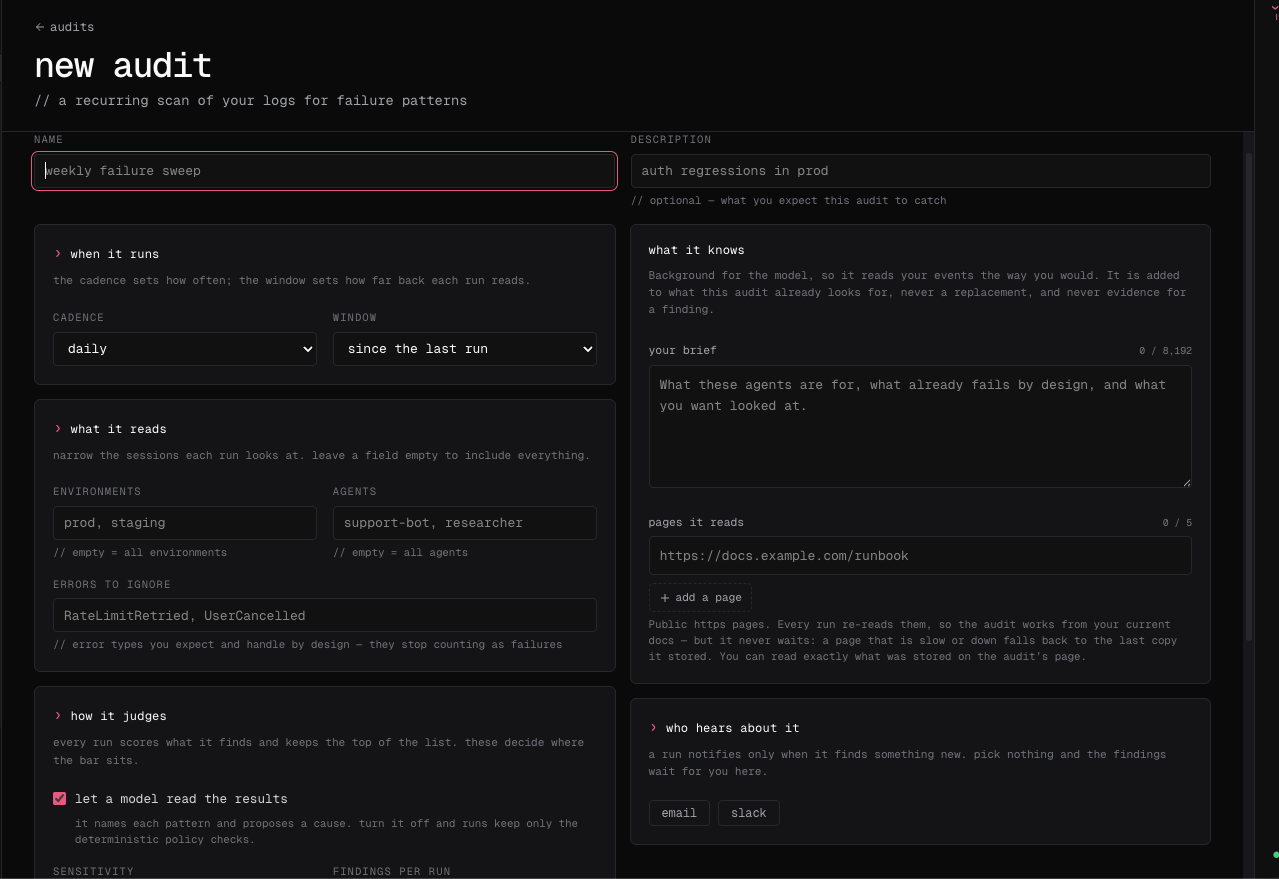
1. Go to **Analyze → Audits → New audit** and enter the name and description.
2. Set the cadence, time window, agent/environment scope, ignored errors, sensitivity, and maximum findings.
3. In **agents**, add or review agent context, then add the operator brief and any public HTTPS reference URLs.
4. Choose notification channels and select **create audit**. The first run queues immediately.
 ```bash theme={null}
fp audits create checkout-reliability \
--description "Find checkout failures that agents do not recover from" \
--scope '{"environments":["production"],"agent_ids":["checkout-agent"]}' \
--schedule-interval-secs 86400 \
--window-mode since_last \
--sensitivity medium \
--text-file ./checkout-audit-brief.txt \
--url https://runbooks.example.com/checkout
```
The first run queues immediately. Include the brief and reference URLs during creation so that run receives them.
See the complete [`fp audits create` reference](/reference/cloud-cli#audits).
Start with a known failed session and several normal sessions. This gives the audit both a positive example and a comparison set.
Audit context is stored as its own resource so editing an audit does not accidentally remove the reference material.
```bash theme={null}
fp audits create checkout-reliability \
--description "Find checkout failures that agents do not recover from" \
--scope '{"environments":["production"],"agent_ids":["checkout-agent"]}' \
--schedule-interval-secs 86400 \
--window-mode since_last \
--sensitivity medium \
--text-file ./checkout-audit-brief.txt \
--url https://runbooks.example.com/checkout
```
The first run queues immediately. Include the brief and reference URLs during creation so that run receives them.
See the complete [`fp audits create` reference](/reference/cloud-cli#audits).
Start with a known failed session and several normal sessions. This gives the audit both a positive example and a comparison set.
Audit context is stored as its own resource so editing an audit does not accidentally remove the reference material.