> ## Documentation Index
> Fetch the complete documentation index at: https://docs.befailproof.ai/llms.txt
> Use this file to discover all available pages before exploring further.
# Custom agents
> Instrument traces from custom agents so Failproof AI can reconstruct runs and find failures.
Instrument traces from a custom agent with `failproofai-sdk` so Failproof AI can reconstruct each run, audit its behavior, and find evidence-backed failures. The SDK writes structured events for the Failproof daemon to deliver to Cloud. It requires Python 3.10 or newer.
Tracing makes custom agents observable and auditable. Preventing an unsafe action before it executes also requires an enforcement hook in your runtime.
To enforce policies in a custom agent setup, [contact Failproof AI](mailto:support@befailproof.ai). We will help map your runtime's model, tool, and lifecycle boundaries to policy hooks.
## Install `failproofai-sdk`
The SDK is currently distributed as a private wheel. Ask your Failproof AI contact for the current version and download access.
```bash theme={null}
VERSION=
pip install "./failproofai_sdk-${VERSION}-py3-none-any.whl"
python -c "import failproofai; print(failproofai.__version__)"
```
With `uv`, download the wheel first and run `uv add ./failproofai_sdk-${VERSION}-py3-none-any.whl`. Pin the wheel in a private artifact repository or dependency lock.
The package is installed as `failproofai-sdk` and imported in Python as `failproofai`.
## Connect the Failproof daemon
1. Go to **Admin → Keys** and create a key with `events:add`.
2. [Connect the Failproof daemon to Cloud](/start/setup#connect-a-machine-to-cloud) on the agent machine.
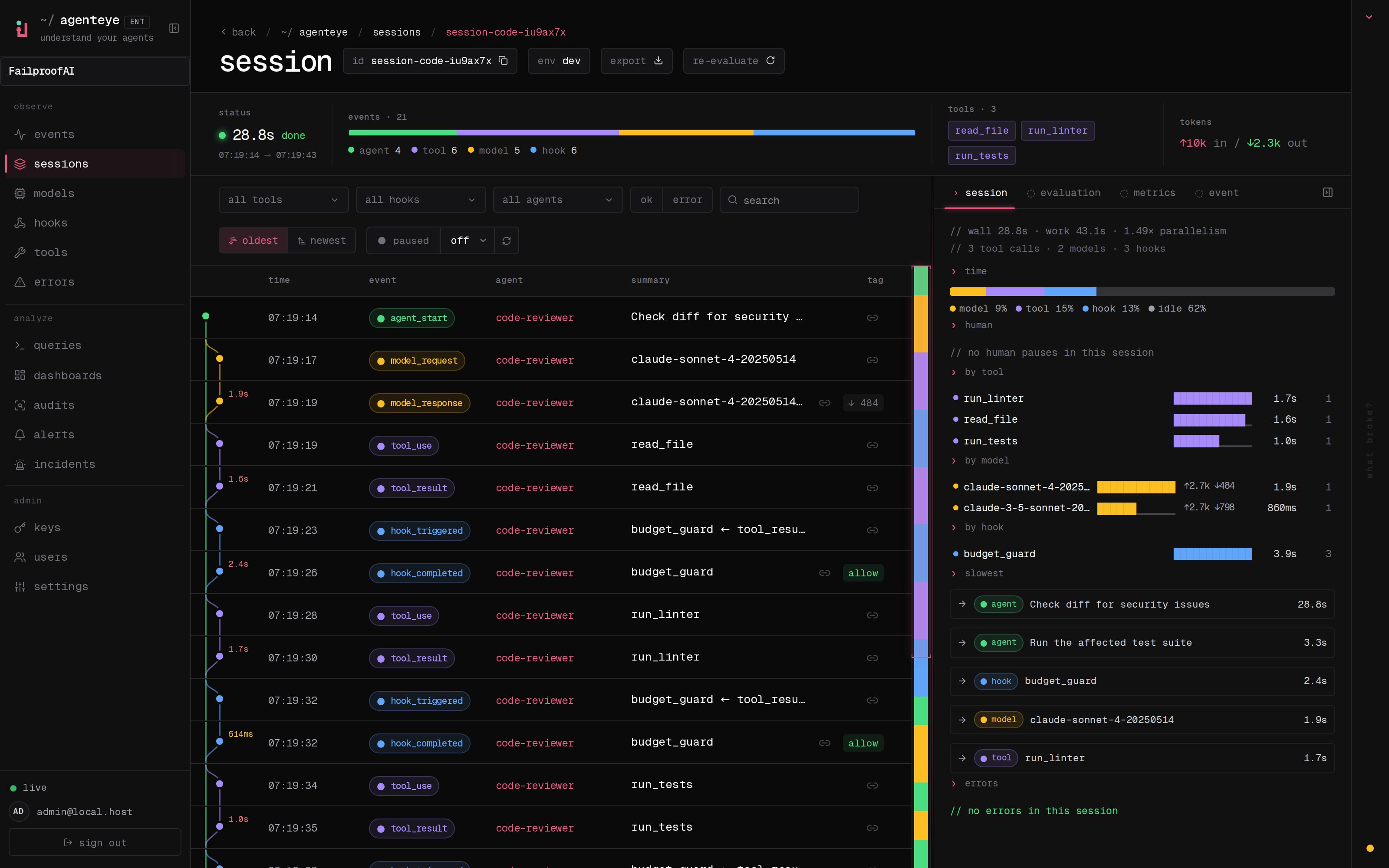
3. Run one instrumented session, then find its exact ID under **Observe → Events**.
4. Go to **Observe → Sessions**, select the same environment, and open the reconstructed trace.
```bash theme={null}
failproofai config \
--connect https://app.befailproof.ai \
--token
failproofai config --status
```
## Instrument a complete run
Call `configure()` once during process startup. Every event call is keyword-only and requires a stable `session_id` and `agent_id`.
```python theme={null}
import traceback
import uuid
import failproofai
failproofai.configure(environment="production")
session_id = uuid.uuid4().hex
agent_id = "checkout-agent"
failproofai.event.agent_start(
session_id=session_id,
agent_id=agent_id,
goal="Resolve a failed checkout",
)
try:
tool_call_id = uuid.uuid4().hex
failproofai.event.tool_use(
session_id=session_id,
agent_id=agent_id,
tool_name="lookup_order",
tool_call_id=tool_call_id,
input={"order_id": "ord_8421"},
)
result = {"status": "payment_failed"}
failproofai.event.tool_result(
session_id=session_id,
agent_id=agent_id,
tool_name="lookup_order",
tool_call_id=tool_call_id,
output=result,
)
except Exception as exc:
failproofai.event.error(
session_id=session_id,
agent_id=agent_id,
error_type=type(exc).__name__,
message=str(exc),
traceback=traceback.format_exc(),
)
failproofai.event.agent_end(
session_id=session_id,
agent_id=agent_id,
outcome="failed",
)
raise
else:
failproofai.event.agent_end(
session_id=session_id,
agent_id=agent_id,
outcome="success",
summary="Escalated the failed payment",
)
```
Emit `agent_start` once per actor. For sub-agents, reuse the parent's `session_id`, give each actor a distinct `agent_id`, and set `parent_id` to the parent **agent ID**, not the session ID.
## Configuration reference
```python theme={null}
failproofai.configure(
base_dir=None,
flush_interval=0.5,
environment="production",
)
```
| Setting | Behavior |
| ------------------ | ----------------------------------------------------------------------- |
| `base_dir` | Explicit spool root. Takes precedence over all environment variables. |
| `flush_interval` | Seconds between background writes from memory to JSONL. Default: `0.5`. |
| `environment` | Deployment label on every event. Defaults to `dev`. |
| `FAILPROOFAI_HOME` | Changes the Failproof AI root that contains the `custom-agents` spool. |
The SDK writes to the explicit `base_dir` when set. Otherwise, it uses the Failproof daemon's `custom-agents` spool under `FAILPROOFAI_HOME` or `~/.failproofai`.
The SDK queues calls in memory and writes batches on a background thread. It also attempts a final flush through Python's `atexit` handling. For short-lived workers, allow normal interpreter shutdown; hard process termination can lose events still in memory.
## Event catalog
All methods return `None`. Fields left as `None` are omitted rather than written as JSON `null`.
| Method | Required fields beyond identity | Optional fields |
| ----------------- | ------------------------------- | -------------------------------------------------------------------------- |
| `agent_start` | — | `goal`, `parent_id` |
| `agent_end` | — | `outcome`, `summary` |
| `agent_pause` | `pause_id` | `reason`, `user_id` |
| `agent_resume` | `pause_id` | `reason`, `user_id` |
| `model_request` | — | `model`, `messages`, `system`, `tools` |
| `model_response` | — | `model`, `stop_reason`, `input_tokens`, `output_tokens`, `content`, `role` |
| `tool_use` | `tool_name`, `tool_call_id` | `input` |
| `tool_result` | `tool_name`, `tool_call_id` | `output`, `error` |
| `hook_triggered` | `hook_name`, `hook_id` | `trigger_event`, `input` |
| `hook_completed` | `hook_name`, `hook_id` | `outcome`, `output`, `error` |
| `error` | `error_type`, `message` | `traceback` |
| `human_wait` | `input_id` | `prompt`, `options`, `reason` |
| `human_input` | `input_id` | `response` |
| `human_pause` | — | `reason`, `user_id` |
| `human_interrupt` | — | `reason`, `user_id`, `at_step` |
Use `outcome="failed"`, `"error"`, `"timeout"`, or `"rejected"` when a completion should count as a failure. Other values, including `"failure"`, are not classified as failures by the current backend.
## Correlation and duration rules
* Reuse the same `tool_call_id`, `hook_id`, `pause_id`, or `input_id` for the matching completion event.
* The SDK computes `duration_ms` for `tool_result`, `hook_completed`, `agent_resume`, and `human_input`. Passing it yourself to those methods raises `ValueError`.
* Tool and hook IDs share one process-wide pending map. Make them globally unique across concurrent sessions and across both namespaces; provider IDs or UUIDs are safest.
* A pair split across processes still correlates downstream, but the SDK cannot compute its in-process duration.
* The pending map holds at most 10,000 starts and evicts the oldest entry when full.
## Custom fields and payloads
Every event accepts extra keyword fields. Use JSON-compatible values when downstream queries need structure. Unsupported leaves such as UUIDs, datetimes, decimals, sets, bytes, and model objects are stringified by the writer.
Reserved custom names are `timestamp`, `session_id`, `agent_id`, `type`, and `environment`. Optional-field typos are accepted as new custom fields, so review emitted JSON when a standard field does not appear in Cloud.
## Deliver and verify
In **Observe → Events**, verify `agent_start` exists first and `agent_end` exists last. Then open **Observe → Sessions** and confirm model, tool, human, hook, and error events appear in the intended order. Use the session ID as the primary troubleshooting key.
```bash theme={null}
failproofai flush --wait --timeout 60
failproofai config --status
fp sessions --since 1h --env production --session-id
fp events --since 1h --session-id --full
```
If Cloud is empty, inspect `$FAILPROOFAI_HOME/custom-agents/events`, otherwise `~/.failproofai/custom-agents/events`. JSONL files prove SDK emission; a growing spool points to daemon configuration or delivery, while an empty spool points to instrumentation or process lifetime.
## Prevent failures in a custom runtime
Use audit findings and linked traces to define the unsafe action, required evidence, and intended response. A custom enforcement integration must expose the action before execution, pass its structured input to the policy engine, and apply the resulting allow, instruct, or deny decision.
Email [support@befailproof.ai](mailto:support@befailproof.ai) to design and validate this integration for your runtime.