Create scoped API keys for machines, automation, and operators.
API keys belong to an organization and carry explicit permissions. Use separate keys for agent ingestion, policy delivery, evaluators, CI automation, and administrative scripts.
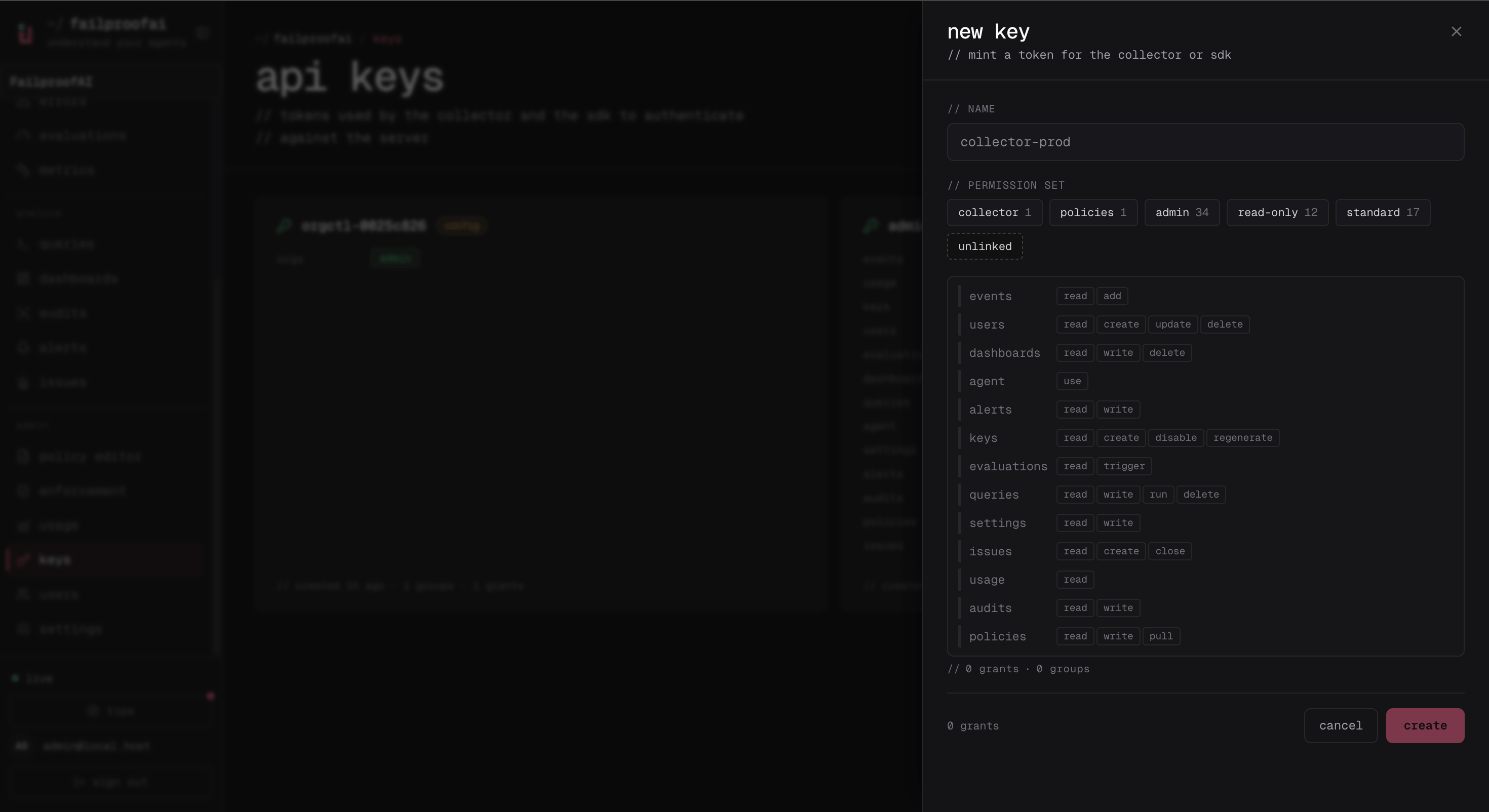
Go to Administration → Keys, select new key, and enter a workload name.
Choose a permission set and adjust individual permissions only when the preset is insufficient.
Create the key and copy its one-time secret immediately.
Open the key later to update grants, disable it, or regenerate the secret.
The creation drawer is where you choose the narrowest grants required by the workload.After creation, the Keys page shows the persistent metadata and management actions. The one-time secret is not shown again.Use this list to review grants regularly and disable keys that no longer map to an active workload.
To run Jev policies through FailproofAI Cloud, select the machine key preset. It adds jev:evaluate to both permissions above. Cloud Jev cannot run with a key that lacks it.Key secrets are shown when created or regenerated. Store them in a secret manager and rotate them without reusing an operator’s interactive credentials.
jev:evaluate (requires events:add and policies:pull)
orgs:admin is reserved for the instance operator and cannot be granted to an organization key or ordinary member. Retired incidents:* and alerts:ack tokens are accepted for compatibility and normalize to current issues:* permissions.Builtin permission sets are read-only, standard, and admin. standard adds evaluation triggering, query execution, issue response, and assistant use to read permissions. Key creation strips human-only grants even when a permission set contains them.
Instance-scoped keys can select an organization with the X-AgentEye-Org header. Set it explicitly on multi-organization deployments; omission may select the default organization.