

Concepts
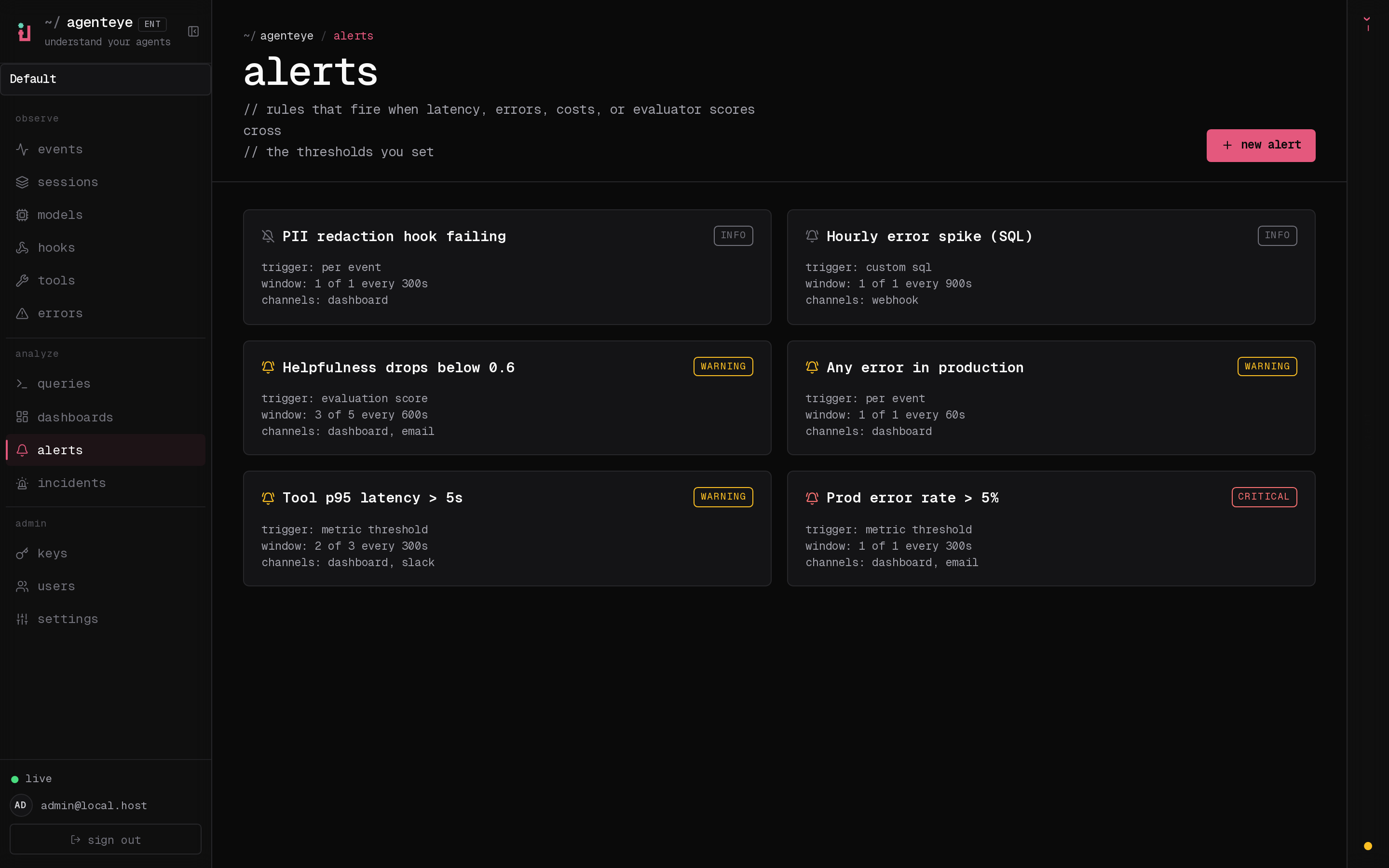
- Alert — the rule. It says what to check (the trigger), how often (the eval interval), when to consider it broken (compound logic), how urgent (severity), and who/where to notify (channels).
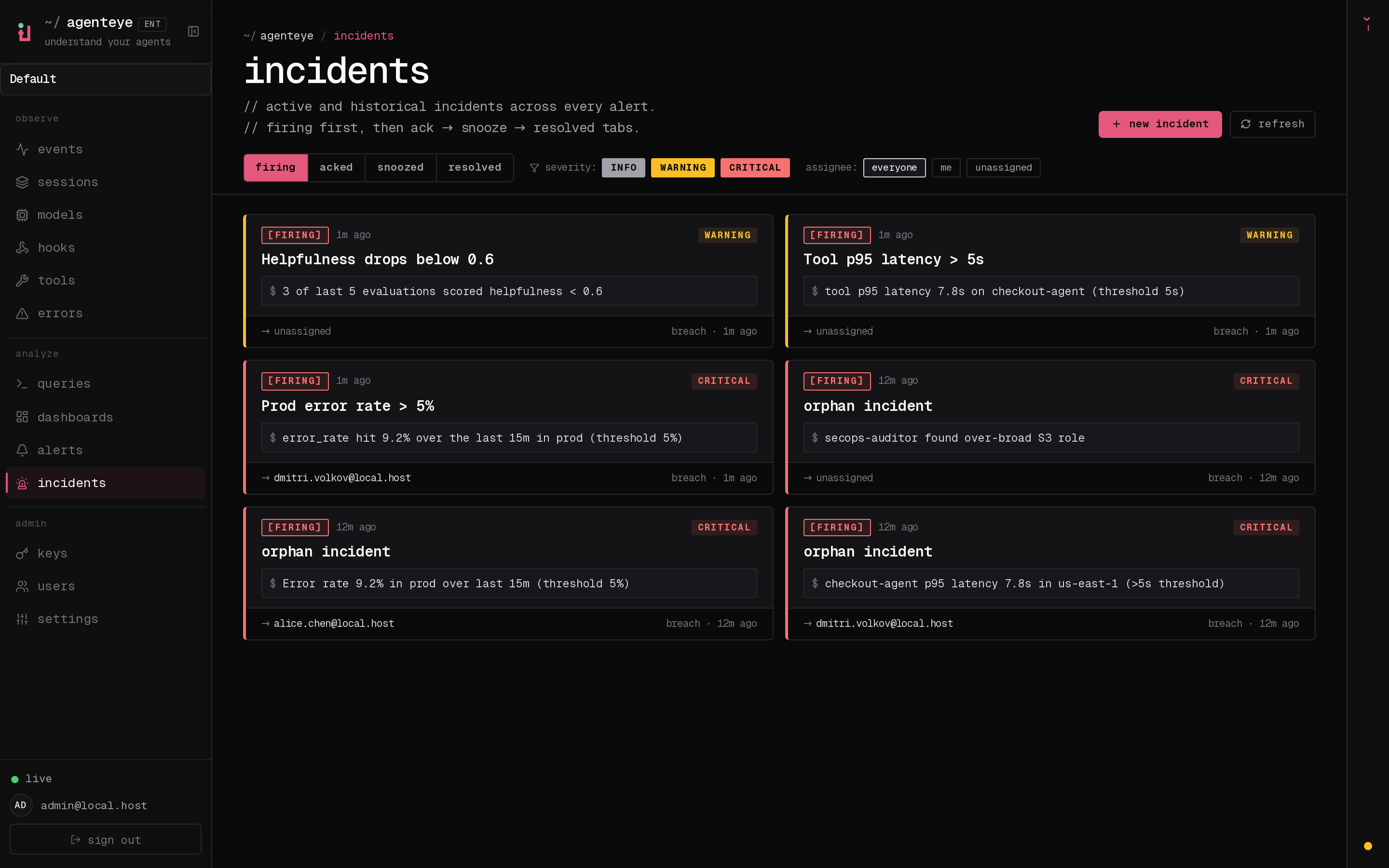
- Incident — what happens when an alert fires. One alert has at most one open incident at a time. Repeated breaches update the same incident’s evidence. Incidents are resolved by an operator; automatic resolution when the rule stops firing is planned but not currently enabled.
- Channel — where a notification goes: email, Slack, generic webhook, or in-dashboard. Each alert can attach any combination.
default org). Incidents can be assigned to an individual operator for triage.
Trigger types
Five kinds, each with its own JSON spec. Pick the one that matches how you want to describe “broken”. The dashboard’s new alert form builds the same spec for you, switching the condition editor to match the trigger type you pick: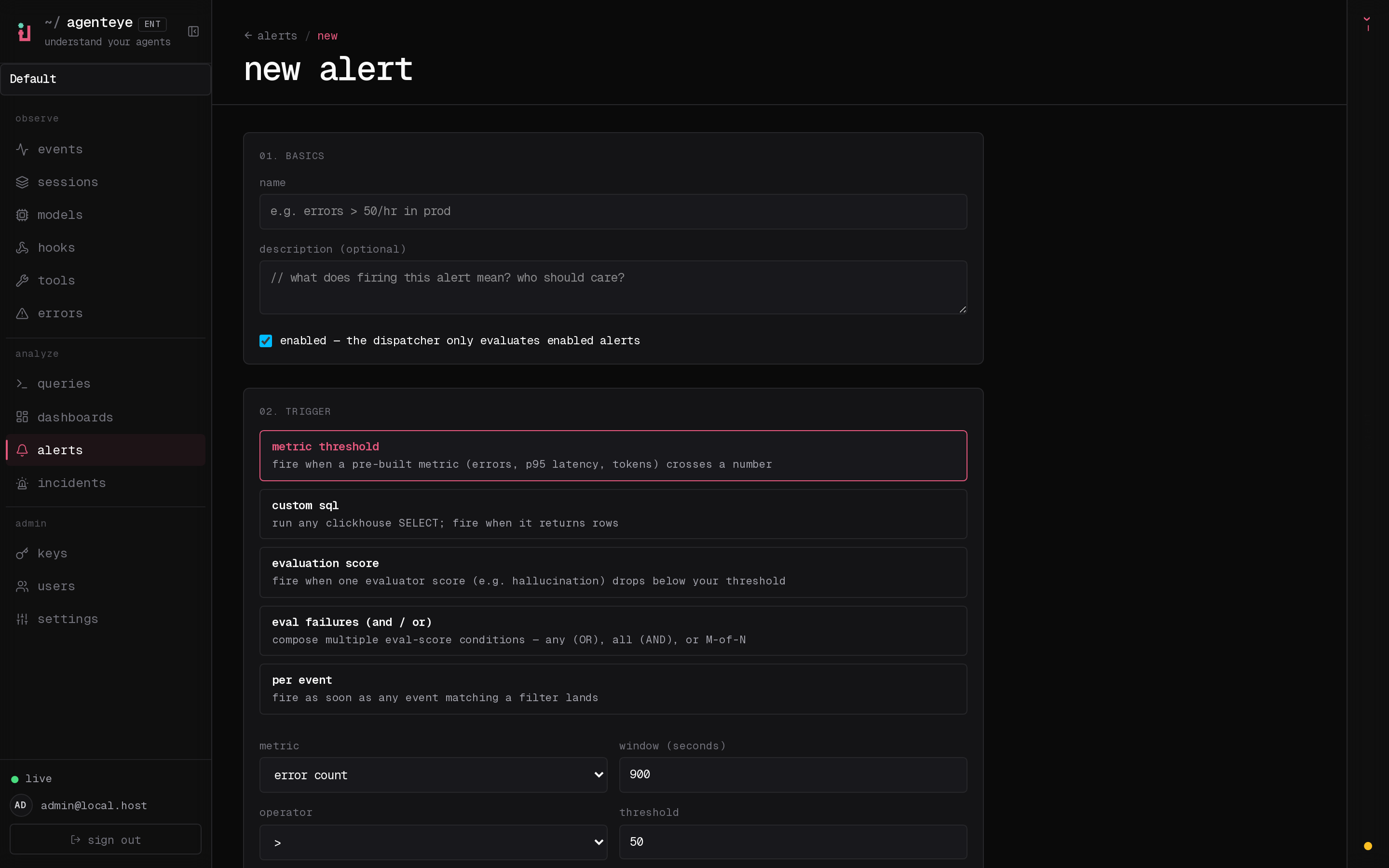
1. metric_threshold
The simplest. Choose a metric from a closed list, an operator, a threshold, and a time window.
| Metric | What it counts |
|---|---|
event_count | Total events in the window |
error_count | event_type = 'error' OR any event with error_type IS NOT NULL |
error_rate | error_count / event_count (0..1) |
p95_latency_ms | quantile(0.95)(duration_ms) across all events with a duration_ms |
p99_latency_ms | quantile(0.99)(duration_ms) |
token_sum | SUM(input_tokens + output_tokens) |
>, >=, <, <=, == (also accepted as gt, gte, lt, lte, eq).
Optional filters: environment, event_type.
Example spec:
2. custom_sql
For anything the preset metrics don’t cover. The operator-supplied SQL goes through the same /queries/run guard (SELECT/WITH only, single statement, 10 000-row cap) before the dispatcher runs it. Two modes:
- rows mode (no
op/value): the alert fires as soon as the query returns at least one row. - value mode: the query must alias one column as
metric_value; the dispatcher compares the first row’smetric_valueagainstvalueusingop.
3. evaluation_score
Reads agenteye.evaluations and compares the average of a named score across a window.
min_count guards against single-sample outliers; the dispatcher won’t fire until at least N evaluations exist in the window.
4. eval_compound
Catch a quality regression that only shows up across several evaluator scores at once. Where evaluation_score watches a single named score, eval_compound composes multiple evaluation-score conditions into one alert and combines their results with a chosen logic; so one rule can express “fire if helpfulness drops or hallucination climbs”, “fire only if helpfulness and tool-efficiency both drop”, or “fire if at least 2 of these three checks breach”.
Each condition reads the average of one named score from agenteye.evaluations over the shared window and tests it with its own operator and threshold. The boolean results are then combined by the combinator:
| Combinator | Logic | Fires when |
|---|---|---|
"any" | OR | at least one condition breaches |
"all" | AND | every condition breaches |
{ "at_least": N } | M-of-N | at least N conditions breach |
combinator:"any","all", or{ "at_least": N }.conditions[]: each{ score_key, op, value }, using the same operators as the other triggers (>,>=,<,<=,==).window_secs: the shared lookback applied to every condition (default3600).min_count: per-condition minimum number of evaluations before that condition can breach; a condition with too few samples in the window counts as “not breached” (default1).environment: optional; restricts every condition to one environment.
5. per_event
For “any event matching X has landed” alerts. No aggregation; the dispatcher fires as soon as it sees a match in the lookback window.
| Field | Purpose |
|---|---|
agent_id | Restrict to errors from a specific agent (the one shown on the /errors row). |
error_type | Restrict to a specific error class (e.g. TimeoutError) rather than every error. |
message_contains | Case-insensitive substring match against payload.message. Useful for catching one specific failure mode (e.g. prompt is too long) without alerting on every error from the same agent. Capped at 200 characters; matched as a literal string, not a pattern. |
lookback_secs to roughly match the alert’s eval_interval_secs so you don’t double-notify on the same event.
Shortcut from /errors: each error group’s representative row on the errors view (and the session event-detail panel for an error event) has a + alert button that opens /alerts/new prefilled with a per_event trigger keyed to that row’s event_type + environment, including a name seeded from the payload’s error_type when present. You still pick channels and confirm the lookback, but the matcher is filled in for you. Operators need alerts:write for the button to appear.
Compound logic (M of N)
Every alert has two integer knobs in addition to the trigger:eval_window: how many recent evaluations to look at (default 1)min_breaches: how many of those must breach before the alert fires (default 1)
1 of 1 (the default) is “fire on the first breach”. 3 of 5 means “fire when the rule has breached 3 of the last 5 evaluations”, useful for jittery signals where a single bad measurement is noise. The dispatcher maintains a ring buffer per alert; you don’t have to manage state.
Eval interval
eval_interval_secs controls how often the dispatcher runs your rule. Clamped to [30, 86400]. Presets in the dashboard: 1m / 5m / 15m / 1h. Pick an interval matched to how fast the underlying signal moves: a 5-minute error-rate alert evaluated every 15 seconds wastes CPU; a per-event alert needs a short lookback or it’ll silently drop events between ticks.
Channels
Each alert can attach any combination of these four. Per-channel credentials (Slack webhook URL, generic webhook URL + signing secret, default email recipients) are configured once in/settings and referenced by key from each alert. This way one Slack channel can serve many alerts without each one storing its own copy of the webhook URL.
The three external channel kinds (email, Slack, webhook) are also gated by an org-wide kill switch, alerts.enabled_channels. When a fired alert attaches a channel kind that is not in this set, the dispatcher skips it and records an alert_notifications row with status skipped_disabled and target <channel_disabled> (letting you globally pause, say, all Slack delivery without editing every rule). The in-dashboard channel is always allowed. See Configuration.
- Per-channel
recipients[]override (when non-empty). - The
alerts.email_default_recipientssetting (an array of email strings).
alert_notifications row with target <smtp_unconfigured> so the audit trail makes the misconfiguration visible.
Slack
Sends a Block Kit message to an incoming webhook URL.- Default URL:
alerts.slack_default_webhook(set in/settings). - Per-alert override: set the channel’s
webhook_setting_keyto any other URL-typed setting key, e.g.alerts.slack_oncall,alerts.slack_costs.
:rotating_light: / :warning: / :bell:), and the message carries a button that deep-links to the incident page.
Generic webhook
A JSON-POST integration for PagerDuty, Opsgenie, or your own ingestion endpoint. Body shape:alerts.webhook_signing_secret is set, the request includes an X-AgentEye-Signature: sha256=<hex> header, the HMAC-SHA256 of the body using the secret. Verify it on the receiving side before trusting the payload.
The header X-AgentEye-Event carries alert.firing / alert.test. (alert.resolved is reserved for the planned auto-resolve feature and is not currently emitted.)
In-dashboard
No external delivery: the alert just writes analert_notifications row that the dashboard’s incidents page surfaces. Useful while you’re tuning a rule and don’t want to spam an external system, or for low-urgency alerts that operators check during normal triage.
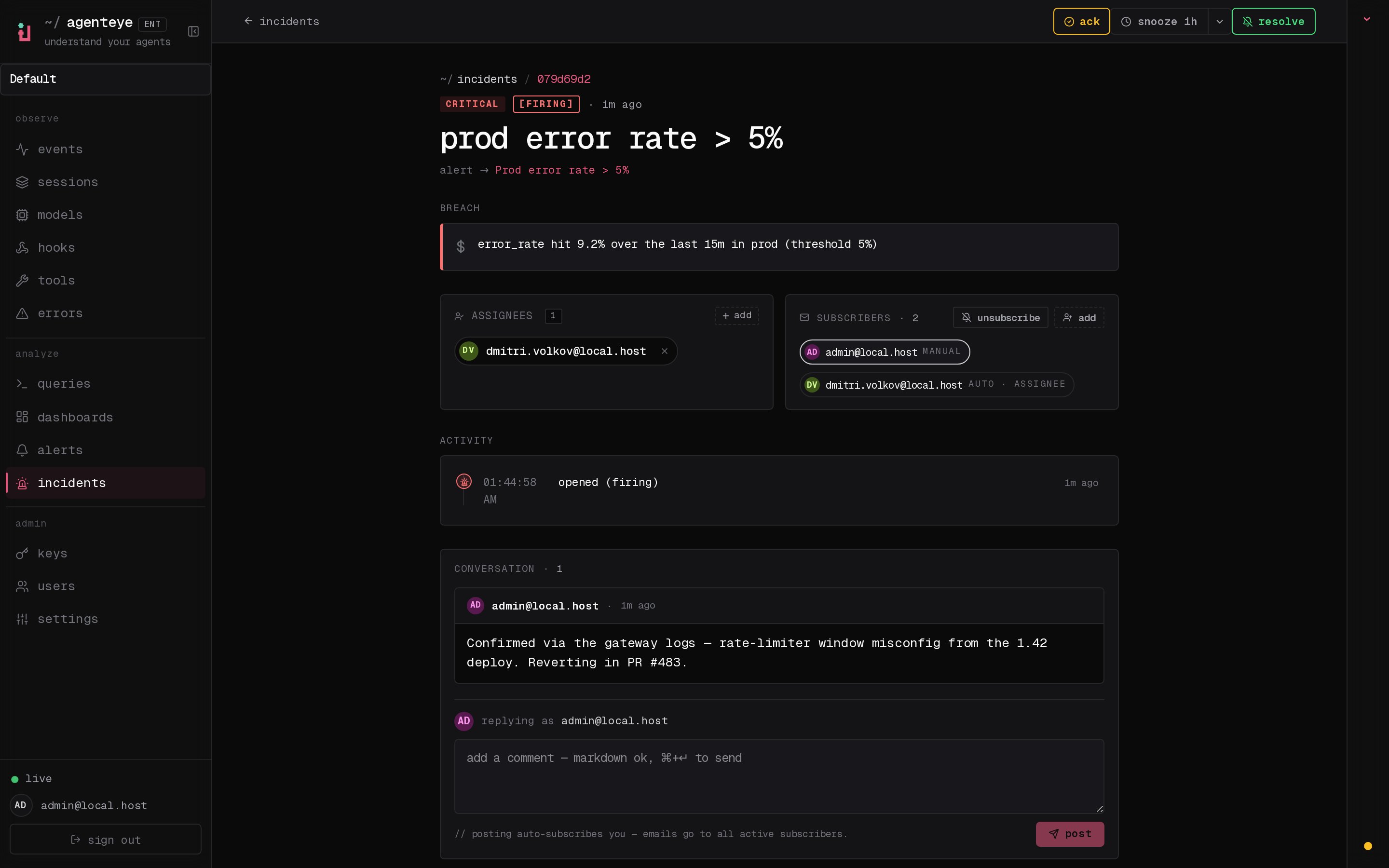
Incident lifecycle
- firing — the dispatcher just opened the incident or detected another breach. The firing notification is fanned out exactly once (gated by the
notified_firing_attimestamp on the incident). - acknowledged — an operator pressed ack on
/incidents/:id. The incident is still considered open; subsequent breaches will update its evidence without re-notifying. - resolved — an operator pressed resolve. Automatic resolution when the rule stops breaching is planned but not currently enabled, so an open incident stays open until an operator resolves it.
Required permissions
Authoring alert rules and triaging incidents are separate concerns with separate grants, so you can give an on-call rotation incident access without also handing it the ability to rewrite the rules.alerts:read: view alert rules.alerts:write: create, edit, delete alert rules, and trigger a test notification.incidents:read: view incidents.incidents:write: open manual (ad-hoc) incidents that are not tied to an alert.incidents:ack: acknowledge, assign, comment on, and resolve incidents.
LegacyGrant on API keys (alerts:ack. Keys and operators that were granted the olderalerts:acktoken keep working: it is honored asincidents:ack(and impliesincidents:read), so existing on-callers retain their access without re-issuing credentials. Issue new grants with theincidents:*family.
POST /keys) and operators (PUT /users/:id). The dashboard’s PermGate locks the relevant buttons when a permission is missing; you’ll see // 403 next to the action.
Email-recipient picker. The alert editor’s recipient picker lists your org’s members so you can pick them by name. It loads for any operator holdingalerts:readoralerts:write; viewing your team’s directory for this purpose does not requireusers:read, and the picker returns only member email addresses, never full user records.
Configuration
Environment variables consumed by the dispatcher:| Var | Default | Purpose |
|---|---|---|
ALERT_WORKERS | 1 | Worker tasks per server instance. Most deployments only need one. |
ALERT_CLAIM_BATCH | 16 | Max alerts a single worker tick processes. |
ALERT_POLL_IDLE_SECS | 5 | Worker sleep when the queue is empty. |
ALERT_REQUEST_TIMEOUT_MS | 15000 | Per-trigger evaluation timeout. |
DASHBOARD_URL | https://app.befailproof.ai | Origin used to build the incident magic-link in notifications. Set to your dashboard host. |
/settings, not env):
alerts.email_default_recipients(email_list): JSON array of email strings — the default recipients for email channels.alerts.slack_default_webhook(url): default Slack incoming-webhook URL.alerts.webhook_default_url(url): default generic-webhook URL.alerts.webhook_signing_secret(secret): HMAC-SHA256 key. Always returned as""in the GET response; type a new value to rotate.alerts.enabled_channels(channel_set): the org-wide set of external channel kinds that are dispatched when an alert fires; defaults to all three (email,slack,webhook). Removing a kind here globally suppresses that channel for every alert without editing each rule. The in-dashboard channel is always delivered and is not affected by this setting.
Verify a new alert
Before relying on a new alert:- Save it as enabled with at least one notification channel.
- Select test on the alert detail page and confirm each configured destination receives the synthetic notification.
- After the first real breach, confirm the incident appears under Incidents and its measured value matches the corresponding dashboard query.
Troubleshooting
| Symptom | Likely cause |
|---|---|
| Alert never fires | enabled = false, or no channels attached, or the underlying CH query returns 0 rows. Use test to confirm channels; use /queries/run to confirm the metric. |
| Slack notification missing | alerts.slack_default_webhook (or the per-alert override key) is unset: check alert_notifications.target for <unset:…> rows; or the slack kind is globally disabled in alerts.enabled_channels: check for alert_notifications rows with status skipped_disabled and target <channel_disabled>. |
| Generic webhook 401 | The recipient is requiring a signature but alerts.webhook_signing_secret is unset. Verify on the recipient that the HMAC matches hmac_sha256(secret, body). |
| Email “from all sends failed” | SMTP credentials wrong or the from address is rejected by your relay. Same surface that ships OTP emails: if those work, the SMTP transport is fine. |
| Incident reopens repeatedly | The compound knobs are too aggressive: try raising min_breaches or eval_window so transient spikes don’t reopen incidents you resolved. |